Wednesday, October 28, 2015

Uncle Barney


Uncle Barney and Me
My stepfather had family that farmed a section of land in East Texas; as a child we would visit the farm.  The farm belonged to his aunt and uncle – Uncle Barney; although they were not my family by blood, I claim them by right of heart. It has been decades since my last visit to that farm; they, and my parents, have long ago passed from this life.
Their home was a small wood-frame farmhouse set upon blocks with a metal roof and a wide front porch accessed by steps that seemed to a 4 year old to go on forever. While they did have electricity, water was hand pumped to the house from an old style well. There was a huge barn set back from the house with corrals for Uncle Barney’s team of mules for plowing and cultivating the farmland; Uncle Barney grew corn and watermelons for a living. In the monetary sense, Uncle Barney and my Aunt were by no means wealthy people, but they were wealthy in other ways – it is impossible to put a dollar value on the love their shared for each other and those around them. I have thought many times what a shame they were never blessed with children of their own.
Visits to the farm were always met with lots of laughter, hugs, and barking dogs running everywhere. First things first after greetings, Uncle Barney would take my hand and off we would go to the barn. He stored hay and corn on the cob for his mules in the barn; he would call the mules up to the barn so I could feed them corn cobs. On many occasions, hand in hand we would walk through the fields of corn and watermelons as he checked the status of the crops and quietly talked about life on the farm. Uncle Barney did not talk much unless it was about farming. At the end of the day, meals were shared at an old table in their big kitchen and afterwards we would all sit on the front porch and watch the sunset. When the weather was bad, after dinner my Aunt would break out the dominos – and all the adults would play while I watched. My how that lady loved to play dominos – and she usually won!
When I was 10, my Aunt, and Uncle Barney left the farm and moved into the city a few blocks from our home. Uncle Barney could no longer work the farm, he had developed Diabetes – he was blind and bedridden. The house they lived in was located between our home and the elementary school I attended. On many afternoons, I would stop by their home to visit with Uncle Barney on my way home from school. He would ask me to read to him – the Bible, sections of the newspaper, sometimes from books from my school’s library; many times he would just hold my hand as he talked about the farm – planting and harvesting, the years of bad weather, the years of good crops, his mules. It was obvious even to a 10 year old this was a man who loved the land. And then one morning Mother told me Uncle Barney has passed away during the night. On one hand, I was glad he was no longer suffering; on the other hand, I felt his passing left a big hole in my heart that could never be filled again.
At one point in my teens, I was going through a particularly stressful time; one night I dreamed of Uncle Barney and the farm. The dream was so vivid I could feel my hand in his, the sun and breeze on my face as we walked across the fields, I could smell the fresh-turned Earth. I heard his voice and although I could not make out the words, a sense of calm just seemed to flood my mind. When I awoke, the problems I faced were still there, but they didn’t seem so overwhelming anymore.
Timed passed and I didn’t actively think of Uncle Barney again until one day years later while driving home from work alone. Traffic was particularly bad that day – bumper to bumper – a large box van was in front of me on the roadway; when we came to an intersection not far from home, the van signaled a left turn. I decided to go around the van by passing on the right using the shoulder of the road. I pulled around beside the van and was about to enter the intersection when I heard a voice screaming at me to stop! I slammed on the brake almost an instant before a car came barreling through the intersection – the driver of the car had run the red light. If I had entered the intersection, he would have broadsided my car on the driver’s side; as fast as he was driving there is no doubt in my mind I would have been killed that day. I recognized the voice that had spoken to me.
As we age we tend to reflect upon the past - remembering people, places, and events that shaped or had an effect on our lives. Some memories are crisp and some are like fleeting shadows through our mind that briefly reach out to us at unexpected times and in unexpected ways. I have often thought about these two particular incidents over the years and have come to the conclusion that if Guardian Angels are real; I have one – Uncle Barney.
To this day, there are times when I can close my eyes and envision that kitchen - the sound of laughter, the smell of my Aunt’s homemade biscuits. I can hear the rain on that metal roof as I lay in bed at night. I can hear Uncle Barney calling the mules to the barn and feel the sun on my face while walking through the fields of watermelons hand in hand - listening to Uncle Barney’s voice.
Simple, but happy times stay in the heart and the mind forever!
In loving memory of -
Uncle Barney
Born: October 7, 1900 – Died: March 16, 1960
Gone but never forgotten!

Monday, October 12, 2015

Deborah's Granola Recipe


For several health reasons, I shy away from consuming wheat or wheat gluten. This has not been an easy task as I have found products containing one or both in surprising numbers – many of them I cannot even understand why the product contains wheat or wheat gluten, like some ice creams!
The one thing I have missed most over the years has been my morning cereal, so this week I decided to find out if granola could serve as a satisfying and tasty replacement for some of the cereal brands I was fond of in the past.
I tried several different recipes and found that none were quite what I wanted – one of the main reasons being the recipes called for way too much sugar and/or other sweeteners. Ultimately, I developed my own recipe and to my surprise my husband really likes it, too!
So, for those of you who may have been considering making your own granola or have used other recipes and found them too sweet for your palate and are fond of pecans– try this one.
Ingredients:

3 cups rolled oats
1 cup slivered almonds
1 cup chopped pecans
¾ cup shredded sweetened coconut
2 level TBS light brown sugar
¼ cup maple syrup (not corn syrup)
¼ cup walnut oil
1 tsp ground cinnamon
½ tsp nutmeg
½ tsp salt
1 cup raisins
Directions:
Preheat oven to 250 degrees Fahrenheit.
Combine the oat, almonds, pecans, and coconut in a large bowl.
In a separate bowl combine brown sugar, maple syrup, walnut oil, cinnamon, nutmeg and salt – mix well and pour mixture in larger bowl with oats, almonds, pecans and coconut.
Mix all ingredients well.
Pour mixture onto a 13 X 18 X 1 sheet pan. Spread mixture evenly in pan with a spatula.
Place pan in oven and set timer for 15 minutes. At alarm, turn mixture with spatula and re-spread evenly in pan. Repeat this process 4 times, so the mixture is baked for approximately one hour. During the last 15 minutes watch the color of the granola – during this time the granola should develop an even golden brown color. If it begins to get too dark cease baking and remove pan from oven.
Allow the granola to cool and then mix in the cup of raisins. Store the granola in an airtight container.
The granola should keep in the airtight container for about a month.

Friday, October 9, 2015

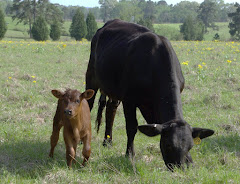
Eight Things I Learned Working With Cattle


I have learned many, many more things than just eight working with cattle; it seems as if I learn something new every day; however, these eight are some of the things I learned early on that have been proven valuable on an on-going basis.
1) Cattle can open gates – many of the livestock gates on the market nowadays have a small, slanted slot about half way up the gate on one side. For deployment in a gateway, the gate has prongs that allow the gate to be mounted on one fence post while a length of chain is used to secure the gate to a solid post on the other side of the gateway. One link of the chain is fitted into the slot and is intended to serve as the “locking” mechanism for the gate. Calves are attracted to things with color or that make tinkling noises as the chains do when wind is rocking the gates or the cattle are brushing against them. After watching a calf stand and play with one of the chains until it became dislodged from the slot allowing the gate to swing open, we began using snap hooks with the chains to prevent the cattle from opening the gates.
2) There is a right and a wrong way to open gates – by nature cattle are nomadic grazers, much like the buffalo herds of old. Humans domesticated cattle and placed them in controlled grazing areas, but the nomadic instinct is still there. So, it is prudent to assume cattle view an open gate as an invitation to access fresh grazing areas; they get excited and sometimes try to rush through an open gate creating a situation in which you may be injured; keep this in mind when entering or leaving areas that contain cattle. When opening gates in areas containing cattle, always pull the gate away from the direction of the cattle. By opening the gate in this manner, you are in effect creating a barrier between you and the cattle; when you move to close the gate it presents a much bigger barrier than your body alone, as well as eliminating the need to step into an open gateway to grab the gate to pull it closed.  In my experience, the slightest movement of the gate towards the cattle is the same as putting up a “red” traffic signal – they understand it means stop now!
3) Cattle love to scratch on things – just like humans, cattle get “itches”; to relieve itches, they scratch on objects. If you want a good laugh watch a cow scratching her rear end or her neck on a downed tree branch. Not so funny is when you catch her scratching on the rear view mirrors of your truck, your baling equipment, barn doors, etc. Bulls are very prone to scratching on objects. They can all be quite destructive trying to quell an itch! We tack barb wire to the barn doors and posts we do not want the cattle scratching on and do not leave equipment where they can access it. We do, however, leave a high stump or two in the pastures so they can relieve those itches!
4) Flowing water is not a barrier to cattle - we have a small creek that flows from our property under one of the perimeter fences onto our neighbor’s property. Because of the geography of the creek, when we pulled the new fences there was a small opening less than 18 inches between the lowest wire and the flowing water. We assumed due to the movement of the water, this would not present a problem – wrong! Our 1600 lb. bull discovered this and used it as an escape route; he took 6 cows with him - real bummer of a day for us! I wish I had had a camera on that spot and watched how he managed to wriggle through that space! After retrieving the escapees, we drove multiple metal posts in the creek spanning the opening, hung cinder blocks from the top of key posts to produce downward thrust and keep the water from pushing the posts out of alignment; then we put barb wire between the posts. That escape route was cut off! J
5) Calves can be goofy – it never fails if there is even a tiny opening in or under the fence, at least one calf will find it and escape. When the Mother realizes her calf is not around to nurse or the calf gets hungry and starts bawling for its Mother is when things get interesting. Both Mother and calf will be bawling and frantically march up and down the fence line. Unless the calf has managed to get out into area where injury is imminent, like a public roadway – I discovered it is best to just note where the calf got through the fence and back off, then come back in about an hour or so after the bawling starts. You will usually find the calf back on your side of the fence happily nursing. The calf will find and come back through the same hole, if not pressured by humans. Plug the hole up so you don’t have a repeat of this – at least not with that particular hole! Calves run and jump playing tag with each other; when you are trying to herd the cattle, they run in every direction except the one you want them to go. It is amazing the amount of trouble they can get into – I found one upside down in a feed trough struggling to get out, luckily she was small enough that I could up-end the trough and literally pour her out of it. They can be very curious and I am never surprised to turn around and find a group of them standing behind me watching what I am doing and then run away when they realize I have seen them.
6) Some cows hide their calves – like deer hide their newly-born fawns while they go off to graze, some cows will do the same with their newborns. They may hide them in tall grass, under bushes or trees. Never drive a vehicle, or any equipment through the pasture where these new Mothers are located unless you know exactly where all the calves are, else you run the risk of running over the calf and killing it. Additionally, when rotating cattle between pastures, take a head count and make sure all the calves get moved with the Mothers.
7) Cattle establish a social order – in any given herd the cattle will establish a social order. The cows can be seen pushing each other around in the pasture and sometimes get really aggressive with each other until one cow emerges as the dominant female; I call her the “Queen of the Pasture”. She will usually be the first through the gate, the first to the water or feed trough and if not, she pushes the others out of the way. Train the “Queen” and the others will follow her lead. If two mature bulls end up in the same pasture, whether they are purposely placed together or one breaks through a fence, it may initiate a struggle for dominance much more aggressive than that of the females. One or both of the bulls may be injured, sometimes to the point the animal(s) injuries prevent them from being used for breeding. It is best to keep mature bulls separated, especially during breeding time. There are few things that make your heart sink faster than watching your registered bull in a fight for dominance with the neighbor’s commercial grade bull that has broken through the perimeter fence!
8) Cattle have a routine – under normal circumstances, cattle develop a routine – time to drink, time to graze, and favorite places to lay in the shade and ruminate. For example, if your cattle typically arrive at a water source to drink twice a day take note of the average time when this is taking place. I can see the pond from my kitchen window, I know approximately what time they come down from the pastures to drink and watch for them; I take a “head-count”. If all are not there or I do not see them within 30 minutes to an hour of their normal time to drink, this is a signal that something has happened - I go out to look for the missing animals. They may have escaped the pasture, predators may be bothering the herd, a gate may have swung closed preventing their reaching the water source (this can be deadly to cattle during times of extreme heat), one of them may have been injured, etc. Being aware of the cattle’s routine can alert you to possible problems, so they can be dealt with expeditiously.
Folks, there is always something new to learn when working with livestock – they can be great teachers if you open your eyes, your mind, and your heart to them!

Wednesday, September 23, 2015

Lucky's Story


"Baby" Lucky
The first time I saw Lucky was while attending the Elkhart Horse Auction one cold November evening in 2003. A young boy standing near the entrance to the Auction facilities with a crate of puppies was diligently attempting to find homes for them.

Never one to pass up an opportunity to hug a puppy – I stopped to talk with the boy about the puppies and a story began to unfold – a litter of puppies, eight altogether, had been found wrapped in a plastic bag dumped alongside a roadway with the litter’s Mother (a border collie) near the young boy’s home. The boy and his brothers rescued the Mother and her litter only to have the Mother die shortly afterwards, so the boys bottle-fed the litter until they were old enough to be weaned and then set about finding homes for each of them.
A Little Sailor Needs a Nap
Lucky and the two other puppies at the Horse Auction were the last of the litter. While talking with the boy I lifted each puppy out of the crate and as I made eye contact with one in particular, I knew this puppy would be going home with me. I named him “Lucky” because after all he had been through he was lucky to be alive.
The Ranch Boss
As of the writing of this story Lucky has been with us for twelve years. He has taken life with us in stride, even on weekends spent on the sailboat. He has always been a laid back kind of guy until somebody says “squirrel”! Or he perceives something or someone in his territory without permission.
A great watch dog and companion, we are “lucky” to have him in our lives. Lucky has since been joined by Slim and Tucker—but that’s another story!


Monday, September 21, 2015

The Value in Training Cattle

Recently I had an appointment in town; as I drove up to the office I noticed a man hurriedly exit through the front door, race to his truck, and speed off. Unfortunately, the man in the truck had been the person I was to meet with; he left suddenly because he had received the dreaded call that all cattle owners hope to never receive, “the cattle are out!” I concluded my business with another employee and while driving home I was reminded of my own experience with the cattle getting out; I doubt I will ever forget that day.

Our original herd started with eleven heifers; from the day they arrived on the property, I began taking steps to train them, and all subsequent cattle, to come when called. This proved to be invaluable the day the cows, with their calves, managed to get through the perimeter fence onto the county road.
Luckily I was home the day this happened; but I was alone. I was working outside in the garden and just happened to look up and see the cows moseying down the roadway, calves by their side, stopping periodically to graze on the roadside grass as they moved towards an intersection less than a mile from our gate.
Now, when something like this happens timing can be critical to avoid disaster. Depending on where the cattle have escaped to, a cattle owner has some options:  1) try to muster a neighbor(s) to help herd the cattle back home,  2) locate a professional cowboy(s) with horses to help round up the herd, or 3) get them back yourself. The problem with the first two options is - you are dependent on other people being available and it takes time to get them on sight. In my case, I did not have time to wait for help; the cattle were not in a neighbor’s pasture, they were on the roadway and headed for the intersection!
I ran to the store room, filled the red bucket I used to give range cubes (treats) to the cattle as part of their training program, jumped in the Nissan Xterra, and stopping just long enough to open the front gate, drove onto the county road and eased up to the herd. The cows recognized the bright yellow Xterra; they stopped to watch it and moved to the side of the road as I slowly drove through and past the herd about 30 yards, then I turned the vehicle around and headed slowly back through the herd. The cows were still standing and staring at the Xterra; immediately past the herd I held the red bucket out the window at arms-length, rattled the treats in the bucket, yelled as loud as I could “come up” and very, very slowly drove back towards the gate to the ranch.
I just kept shaking that bucket extended out the window and yelling “come up”. My arm and hand were aching, my heart was pounding, I was praying those girls would obey me and no other vehicles would come down that road and frighten the herd, especially the calves, or hit one of them! I was about 60 – 70 feet from the herd, watching them in the rear view mirror, when as a group the cows turned and started to follow the Xterra. Yes, yes, yes!
Down the road we went like the Pied Piper, but with really large mice, to the music of those treats shaking in the red bucket, and my yelling “come up” – the calves bringing up the rear  - through the front gate and to the back pasture where I secured the herd. As I drove back to the house, the cows were happily munching the treats I poured from the red bucket!
The fence failed for several reasons – this pasture was originally just used for hay; its perimeter fence was composed of 4 strands of 2 barb wire with pull posts at each end of a 500 foot run of a fence line which was slightly curved as it followed the property lines along the roadway.  Shade is provided by trees along the roadway. As temperatures heated up during the day, the cattle sought relief from the heat by spreading out along the fence line and laying underneath the shades trees. This particular day, the cattle were attracted to a neighbor’s cattle across the roadway and so were concentrated together and pressing on the fence in one area.  This combination of factors exerted enough pressure on the fence to break two wires, thus creating a large enough opening for the cattle to escape.
We replaced the fencing with 6 strands of 4 barb wire, replaced all the metal t-posts with stout wooden posts, and additional pull-posts in the curved areas to better tighten the wire.  This not only gives more strength to the entire fence, but discourages the cattle from pressing on the wire or putting their heads between the wires and stretching it out of place.
Lessons learned – 1) we changed the use of this particular pasture - we should have reassessed the fencing taking into account the possibility of cattle across the roadway and strengthened the fence before it failed, and 2) the time and effort put into training the cattle paid off; when I needed it most the repetitious training kicked in and the cattle trusted if they came when called they would be rewarded, it’s just that simple. Not only did this training allow me to easily move the cattle within our pastures or into the corral as needed; it ultimately saved an unexpected situation from becoming a disaster.

Wednesday, September 16, 2015

The Real Gold

During a phone conversa - tion recently the caller expressed concern about a possible economic collapse in our country and asked me if I thought gold was good insurance in case this happened; I posed two questions as my response, 1) can you truly afford to lose money, perhaps a lot of money, and 2) in the event of a major disaster, do you feel confident that someone with food, knowing they may not be able to get more anytime in the near future, would be willing to sell their food – for any price? If yes, buy the gold, if not, rethink what you can buy that will provide the best value for your money towards disaster insurance.

I have seen gold prices as much as $2200.00 an ounce; as I write this today I found it for $1323.00 an ounce. So, anyone buying gold at $2200.00 an ounce has already lost $877.00 towards their “disaster insurance”. Precious metals are no different than the stock market; one day you might be a millionaire – the next day a pauper. This is not to say that you cannot make money if you buy when the price of gold is low and sell when it is high; however, in general, the people getting wealthy are the ones selling the gold, not the buyers.
If people want to spend their money buying gold as their insurance against disaster, I respect their decision; I do not personally embrace this method of preparing for disaster. It all boils down to most Americans cannot financially afford to own gold, but beyond that – you cannot eat gold! You can buy a lot of food for $2200.00 or $1323.00. In my opinion, buying gold in the absence of a well-managed food storage plan, is like buying “fool’s gold” – you are not getting the best value for the money you have to spend.
Every time a commercial airs on television touting ownership of gold to ensure economic well-being, I am reminded of the gold rush days in America, when miners were paying $8.00 for a bag of salt, $3.00 for an egg, or $20.00 for a steak that before the strike was $.25. Who was really wealthy under these circumstances – it was not the people with the gold! It was the people that owned and sold the necessities of life; they not only had the where will all to sustain themselves and their families, they had the ability to become wealthy by selling the necessities to people in need of these items with much less risk and hardship.
I recall a conversation between my Mother and I; Mother was a child during the Great Depression. One day I asked her how difficult it was for her and her family to live through this time in our country. Surprisingly, she said they hardly realized there was a depression; they lived on a small farm and raised or grew the bulk of their food. If they needed something the farm did not or could not produce, they bartered food for it. Prior to World War II, most Americans lived on farms and ranches; after World War II there was a mass exodus to the city and jobs in the factories.
I grew up in the city and as I aged I realized many Americans have lost much of the knowledge our ancestors used to sustain themselves, like gardening, animal husbandry, carpentry, hunting and fishing, etc. Gone are the days when most Americans owned a few acres on which to provide for themselves; the majority live in apartment complexes or on postage stamp size lots in the city or suburbs. They buy their food in the local supermarket, a few days’ worth at a time, so it will not spoil.
Prior to World War II, as had people on this planet for thousands of years before that, individuals and families  - our ancestors - prepared to sustain themselves through uncertain times by raising and growing their own food, then harvesting and preparing that food for storage – it was either canned, dried, salted, or stored in root cellars. This was their “gold” – their insurance against hard times.
Today, when word of a pending disaster is spread, people rush to the supermarket to “stock up” on necessities – not gold. The reality is that in America today, our supermarkets have on hand a few days’ worth of food at most and are unable to supply hundreds of people in the immediate area with emergency supplies in a matter of hours. A few days after Hurricane Ike went through our area, out of curiosity I went to a nearby supermarket, it looked like a plague of locust had been through it; not even a can of dog food was left on the shelves.
Disasters can take many forms - civil unrest, earthquakes, floods, forest fires, blizzards, hurricanes, meteor showers, drought – and wars. Loss of employment can mean financial disaster for many Americans. When Hurricane Rita, a Category 3 storm, hit East Texas in 2005, it caused wide spread flooding from storm surges, heavy rain and high winds. There were residents of East Texas without electricity and running water for months. We can never fully predict the future, we can only prepare to the weather the “storms” we encounter in life as best we can. Attempts to prepare should not take place the day before the disaster hits!
Today, people who prepare to weather the hard times might be called – dare I say the word - “Preppers”! I have heard all the jokes and all the different definitions for “Preppers” – but the one that truly represents this group of people is – “a Prepper is a person who takes personal responsibility and self-reliance seriously”. Granted some people take prepping to an extreme, like moving to the wilds of Alaska or living in a cave in the Arizona desert – hey, I don’t have a problem with someone who feels this is right for them; but for most Americans, this is not reality or a desired life-style.
There is a particular group that encourages its members to store at least one year’s worth of food as a buffer against hard times; however, starting out with a one to three month supply is a good goal and can be expanded, if desired, as you become knowledgeable. Even a two-week supply is more than some people keep on hand!
There are a lot of reasons why storing food is smart, 1) foremost, it may save your life and that of your family in the event of a disaster, 2) it is a buffer against rising prices in food – you can buy bulk supplies of staple goods on sale, i.e., canned vegetables, sugar, flour, grains, beans, etc., thereby saving money, 3) stored food can help sustain you and your family through economic hardships, such as job losses or major health issues, 4) it can, particularly specialty items, be used as barter, and last but not least,  5) it provides  a sense of security in a World seemingly gone insane!
All Americans should take responsibility for learning to grow their own food – be it in their back yard or as part of a community garden. All Americans should have a food storage plan as a buffer against disaster. I hear people say they don’t have the money to buy extra food just to store it; the question is – can you afford not to do so? With a good food storage plan, the food is not just being stored; it is rotated and replaced as used so the amount on hand does not fall below sustainable levels. Everyone can find some extra money in their budget – quit smoking cigarettes, rent a movie for the entire family to watch at home instead of going to the movies and spending a small fortune on junk food while there, forego that $100.00 dress that you don’t need – the money is there, look for it!
Developing a personal food storage plan can be a challenge, but it can also be fun. A well thought out, well managed food storage plan is worth its weight in gold. If someone calls you a “Prepper” just smile and take it as a compliment – because one day you may be the person with the “real gold”, the priceless bags of salt, rice, beans and sugar!

Monday, September 14, 2015

Ten Things to Consider When Selecting an Apiary Location

For the novice beekeeper, locating his/her hives in an area that is conducive to regular visits is very important for two reasons—watching the activity of the bees in and around each hive is part of the learning process; it helps to differentiate between what is normal bee hive activity and what is not. This is essential to successful beekeeping!
 
Additionally, new hives will require regular monitoring to ensure the queen bee has been released, (as is the case with “package bees”), the queen is present in the hive and laying eggs, and the overall population and health of the colony is progressing as expected.
 
Here are ten things to consider when selecting a location for your apiary:
 
Check out local laws and restrictions.  This is absolutely the first step in your plan for beekeeping! The location of your apiary may be limited by local ordinances and other restrictions, including homeowner association rules and regulations. Additionally, permits may be required. It is best to be aware of and deal with these issues early in the decision making process or you may find yourself on the nasty end of a lawsuit.
 
Locate the hives near a clean source of water. Bees use a lot of water, not only for satisfying their own thirst, but to help cool the hive during the heat of our long, hot Texas summers. Do not place the hive in a gulley—the air will be damp and still, thus creating an unhealthy environment. If there is not a nearby source of clean water, you will need to provide one for them.
 
Placing a bird bath or other shallow water source near your hives with some small rocks above water level for the bees to safely land on and drink will provide adequate water.  If you will not be able to check on your bee’s water source daily, a 5-gallon bucket will suffice. Drill some small drainage holes a few inches from the top of the bucket. Fill the bucket to just below the drainage holes and drop some Styrofoam packing kernels in the bucket. The rain will help to renew the water in the bucket, the packing kernels provide “landing pads” for the bees to perch on and avoid drowning while drinking, and the drain holes keep the bucket from filling up and dumping the packing kernels out of the bucket. In the best case scenario, the rain will keep it filled, but check on it regularly, and keep the bucket filled, clean, and sanitary. You can also buy commercially available watering devices for your bees.
 
The apiary must be accessible by vehicle. Bee hives, when filled with bees and honey, can be very heavy; ensure you can easily get a vehicle into and out of the apiary for hive setup and maintenance. Save your back, ensure you can park directly behind or beside your hives! Having your vehicle on hand is convenient for accessing tools and equipment parts as needed while inspecting your hives or pulling honey supers from the hive for honey extraction.
Keep in mind relocation of your hives may be required during emergency situations, such as forest fires or rising tides from an approaching tropical storm. Have a plan for emergency evacuation of your hives!
Provide some security and privacy for your bees. It is advisable to place your hives in a fenced, locked area so they are less apt to be seen by passersby. Beekeepers have had their hives destroyed by vandals and even stolen. Fencing will additionally keep small children, pets, and livestock away from the hives, as well as known “hive raiders”, such as skunks. There is some evidence that bees are sensitive to the presence of horses – give this serious consideration when selecting a location for your hives. Do not locate your hive adjacent to areas of high foot traffic or areas, such as patios where food will be served, especially sweets, or you will have uninvited guests - many, many of them!
Place your hive on firm ground with good drainage. If placed on ground that has poor drainage or very loose soil, you run the risk of the hive becoming unstable. As it sinks into the soil, it may collapse and kill your bees. Beekeepers placing their hives in areas with poor drainage risk vehicles becoming mired in mud as well, and the area may become totally inaccessible, even by foot, during certain times of the year.
Adequate sunlight and shade. The hives should have southern or eastern exposure to provide adequate sunlight. Place the hives facing southeast, so the sun pours into the hive entrance and serves as an alarm clock to wake up your bees. Avoid placing the hives in deep shade from trees or structures. Your hives will do well with non-evergreen trees located to the west and southwest of their position as they will receive afternoon shade during the summer’s peak temperatures, and benefit from the sun’s warming rays during the late fall and winter.
Provide windbreaks in the direction of the prevailing winds.  Placing your hives behind a windbreak - and additionally wrapping each hive if the winter is extremely cold and/or windy - will help the bees maintain required heat levels during severe weather and reduce consumption of winter food stores in the hive. DO NOT BLOCK THE HIVE ENTRANCE UNDER ANY CIRCUMSTANCES!
Avoid placing the hive on a hilltop where it can be buffeted by winter winds or in gullies where the air will be damp and still.
Setting the Hive in Place
Do not set the hive in contact with the ground. To minimize damp conditions and reduce deterioration of the hive’s woodenware, the bottom board of the hive should not be set directly on the ground. Any number of solutions to this issue is available from commercially offered hive stands to placing the hive on concrete blocks, or homemade tables, etc. As the colony grows and additional brood boxes/honey supers are added to the hive, the stand upon which the hive has been placed must be sturdy enough to support the added weigh and remain stable or the hive may collapse.  Some beekeepers in areas prone to raids by skunks place their hives on stands at least 18 inches off the ground – as the “raiders” stretch to reach the hive entrance, their underbelly is exposed to the bees’ sting. Do not make tables or stands so high you cannot safely lift the boxes off the hive for maintenance or honey harvest.
Further deterring of unwanted visitors can be achieved by placing a board with protruding tacks in front of the hive—it will be extremely uncomfortable footing. As an alternative, a small roll of barbed or other wire that will not block access by the bees, but keep predators from reaching the hive entrance, may be employed.
Mulch or old carpet placed around the hive will keep down weeds and tall grasses, so the hive is easily accessible by bees in flight. If using a screened bottom board - clear, accessible space beneath the hive will enhance keeping the area clean of debris.
Tilt hive and face away from prevailing winds. The hive, when set in place, is best facing away from prevailing winds to aid the bees in keeping the hive warm during inclement weather. Tilt the hive very slightly forward. Inevitably rain will blow inside the hive, by tilting the hive slightly forward the water will automatically drain once the storm has passed. This will keep the hive’s bottom board and entrance dry and free from mildew and mold.
Place a small weight on outer hive cover.  High winds can easily blow the cover off your hive and expose the bees to rain, wind, and chilling temperatures thus killing your bees. Reduce the chance of this happening by placing some weight on the hive cover - a small rock or two will usually be sufficient. Small, flat concrete garden border blocks work well.
Bottom line, the time to make decisions about how and where to setup your hive is not the day you take possession of the bees. Some forethought will get your beekeeping venture off to the good start!